A Practical Introduction to Apache Airflow
Apache Airflow is a platform for defining, scheduling, and observing workflows. It represents a workflow as a directed acyclic graph (DAG): a set of tasks with declared dependencies. This is useful when work must run in a reliable order, be scheduled repeatedly, and remain observable when something fails.
Airflow is an orchestrator rather than the system that performs every piece of data processing itself. A task might fetch data, run a transformation job, wait for an external event, or trigger another system. Airflow coordinates those steps and records what happened along the way.
The core idea: a DAG
The DAG describes both the individual pieces of work and the relationships between them. Dependencies determine which tasks must complete before another task can begin; a DAG cannot contain a cycle that eventually points back to an earlier task.

The graph view makes a workflow easier to inspect: which tasks ran, where a failure occurred, and which tasks are waiting on an upstream dependency.

Control flow
DAGs are designed to run repeatedly. A task can depend on one or more upstream tasks, and those dependencies make the expected order of execution explicit. Airflow users often express that relationship using the » and « operators.
Tasks, operators, and sensors
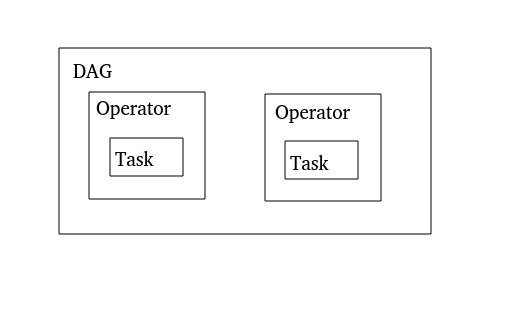
Tasks are the units of work in a DAG. Operators and task decorators provide reusable ways to define what a task does, while sensors are designed to wait for an external condition or event. Keeping tasks narrow makes a workflow easier to reason about and operate.
When Airflow is useful
Airflow earns its place when a workflow has dependencies, retries, schedules, or operational visibility requirements. Examples include a daily ingestion and transformation sequence, a batch job that should wait for a source file, or a workflow that needs a clear record when a downstream step fails.
For a small, independent script, Airflow may be unnecessary. The value comes from making multi-step work explicit, repeatable, and observable.
Practical principles
- Keep tasks narrow and make retry behaviour intentional.
- Treat the DAG as orchestration code, not as the place to pass large datasets between tasks.
- Make task dependencies clear enough that an operator can understand the impact of a failure.
- Start with the workflow and operational need, then choose the simplest deployment that supports it.
For current terminology and deployment guidance, see the Apache Airflow architecture overview.
Enjoy Reading This Article?
Here are some more articles you might like to read next: